Guided by our Drug Discovery Strategy of “creating unique and innovative new drugs,” we have designated on oncology, immunology & inflammation and neurology as our priority areas, focusing on deepening our biological knowledge and understanding of disease onset and progression, while actively promoting open innovation and working to strengthen our drug discovery capabilities. In addition, we are working to improve the quality and speed of drug discovery research by utilizing digital technologies, while also strengthening translational research to bridge basic and clinical research. As of May 2025, there are 24 drug candidates currently in the clinical stage, of which 16 are in-house discovered. From the early research stage, we actively utilize research tools such as human genome information and human iPS cells, as well as informatics technologies, to analyze the relevance of target molecules to diseases, identify biomarkers that can more accurately predict and evaluate the efficacy of new drug candidates in humans, and thereby improve the probability of success in drug discovery.

Ono’s Focus Fields
We have identified on oncology, immunology & inflammation and neurology areas as priority areas where there is a high level of medical needs, based upon our drug discovery strategy of “creating unique and innovative new drugs.” We leverage our strengths in each priority area in efforts to discover drugs to treat illnesses with a high degree of medical need for which current treatments are unsatisfactory.
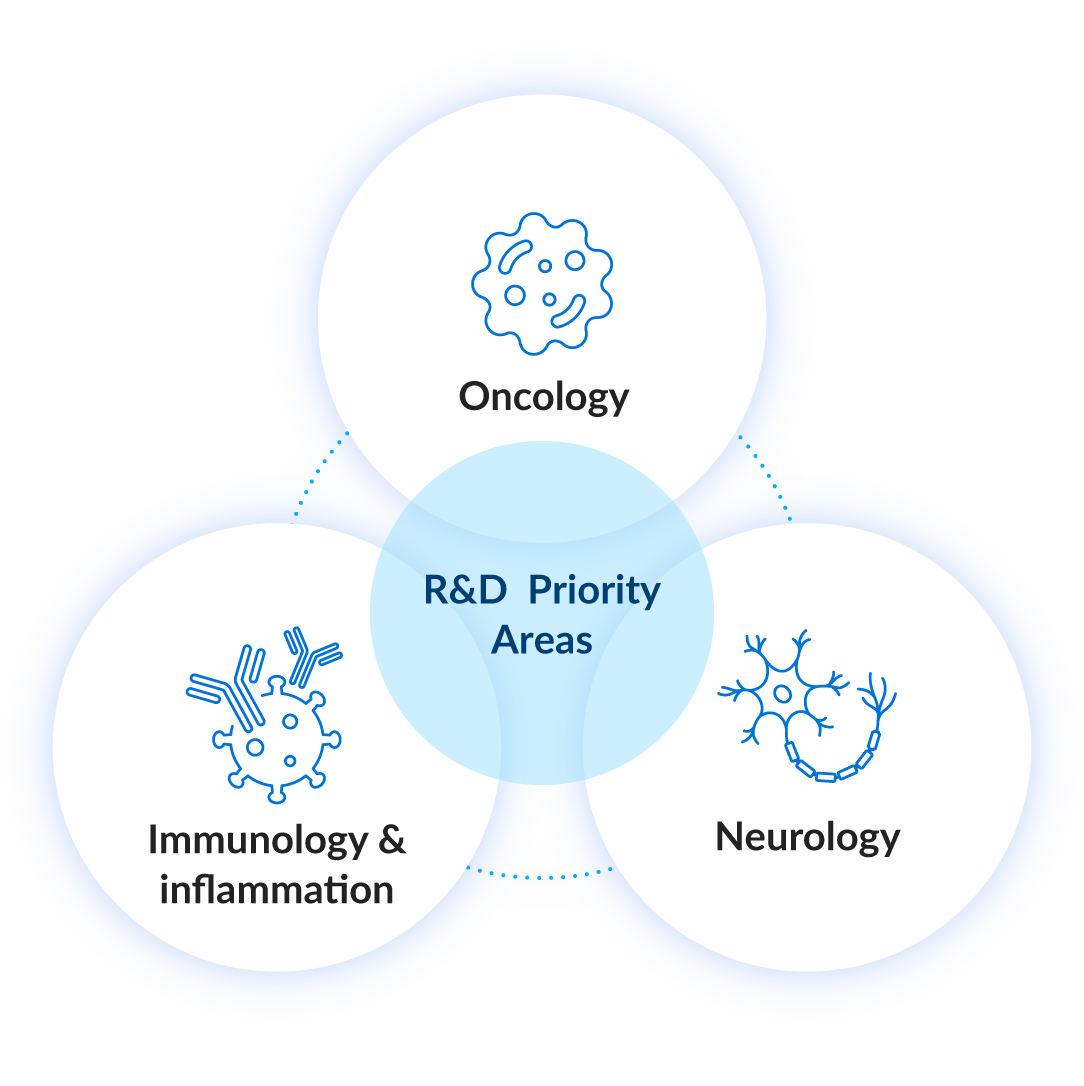
A Drug Discovery System in Each of the Three Priority Areas

Oncology (Research Center of Oncology)
As a pioneer in cancer immunotherapy, the Center works toward discovering innovative drugs for cancer patients with the experience, techniques, and know-how we nurtured through R&D of the immune checkpoint inhibitor OPDIVO. The Center is pursuing original and unique drug seeds and new drug modalities through open innovation with academia and bio-pharmaceutical companies around the world with cutting edge technologies, and by promoting translational research.
Immunology & Inflammation (Research Center of Immunology)
We are committed to creating innovative new drugs by deeply understanding the underlying biological characteristics of immune mediated inflammatory diseases with high unmet medical needs at the molecular and genetic levels, and by integrating diverse and advanced drug discovery technologies. Through this approach, we aim to improve symptoms, achieve durable remissions, and ultimately lead to cures in the future, thereby transforming existing treatment paradigms.
Neurology (Research Center of Neurology)
The Center focuses on not only neurons as major components of the nervous system, but also glial cells, which maintain and support the environment necessary for the survival and function of neurons. Through its intensive analysis of patient-derived tissues and iPS cells, the Center is dedicated to discovering innovative drugs to provide disease-modifying therapies, as well as symptomatic treatments, to patients with neurodegenerative diseases, which are becoming serious problems in the aging society, and those with mental disorders or chronic pain, which are detrimental to society.
Case Examples
Research Center of OncologyONO-4578/EP4 antagonist
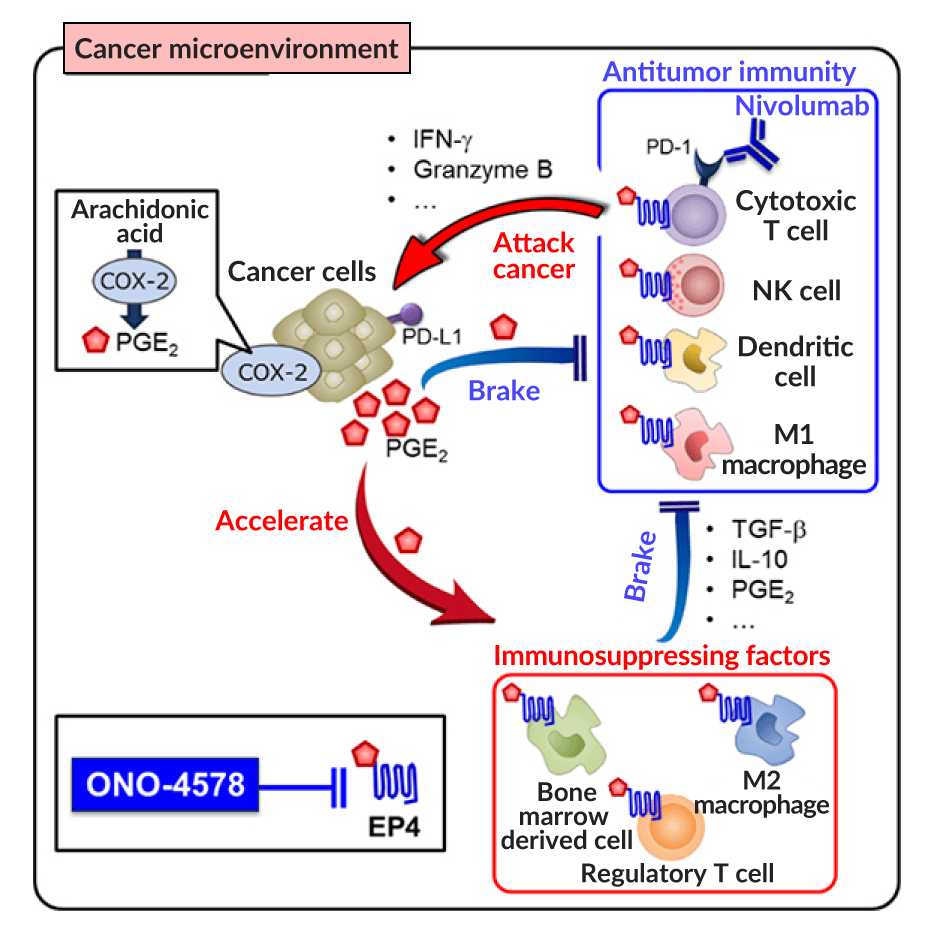
Prostaglandin E2 (PGE2) produced by cancer cells acts on PGE2 receptor EP4 expressed on various immune cells to suppress the action of cancer immunity. ONO-4578 is expected to restore cancer immunity and attack cancer cells by blocking EP4.
COX-2 enzymes expressed on cancer cells produce PGE2, which suppresses the action of cancer immunity through EP4 expressed on various immune cells.
ONO-4578 is a selective antagonist of EP4. Nonclinical experiments have shown that ONO-4578 exerts its antitumor effect by suppressing the action of PGE2 and restoring cancer immunity.
It is also expected to enhance the antitumor effect of our anti-PD-1 antibody nivolumab (Opdivo®).
Research Center of ImmunologyONO-4685/PD-1×CD3 bispecific antibody
PD-1 is a receptor expressed on activated T-cells that inhibits activation signals of the immune system. CD3 is a component of T-cell activating receptor.
ONO-4685 is a bispecific antibody that targets both PD-1 and CD3, uniquely designed by Research Center of Immunology based on a hypothesis. Clinical trials of ONO-4685 are underway with an expectation of a new treatment for autoimmune diseases.
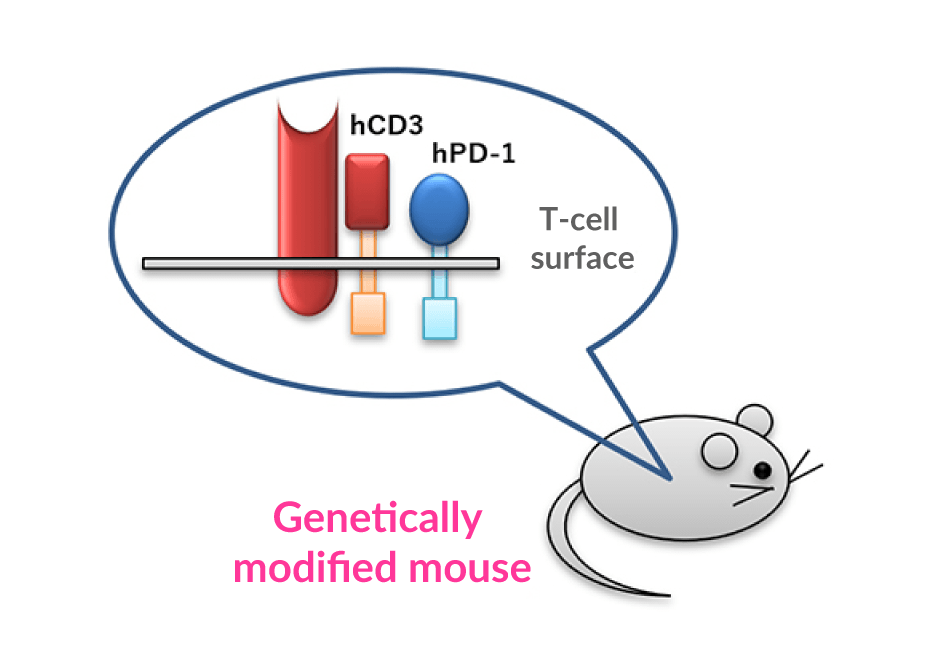
Using our developed genetically modified mice, the Research Center of Immunology has verified the hypothesis that ONO-4685 suppresses activated T-cells and shows efficacy in an autoimmune disease model.